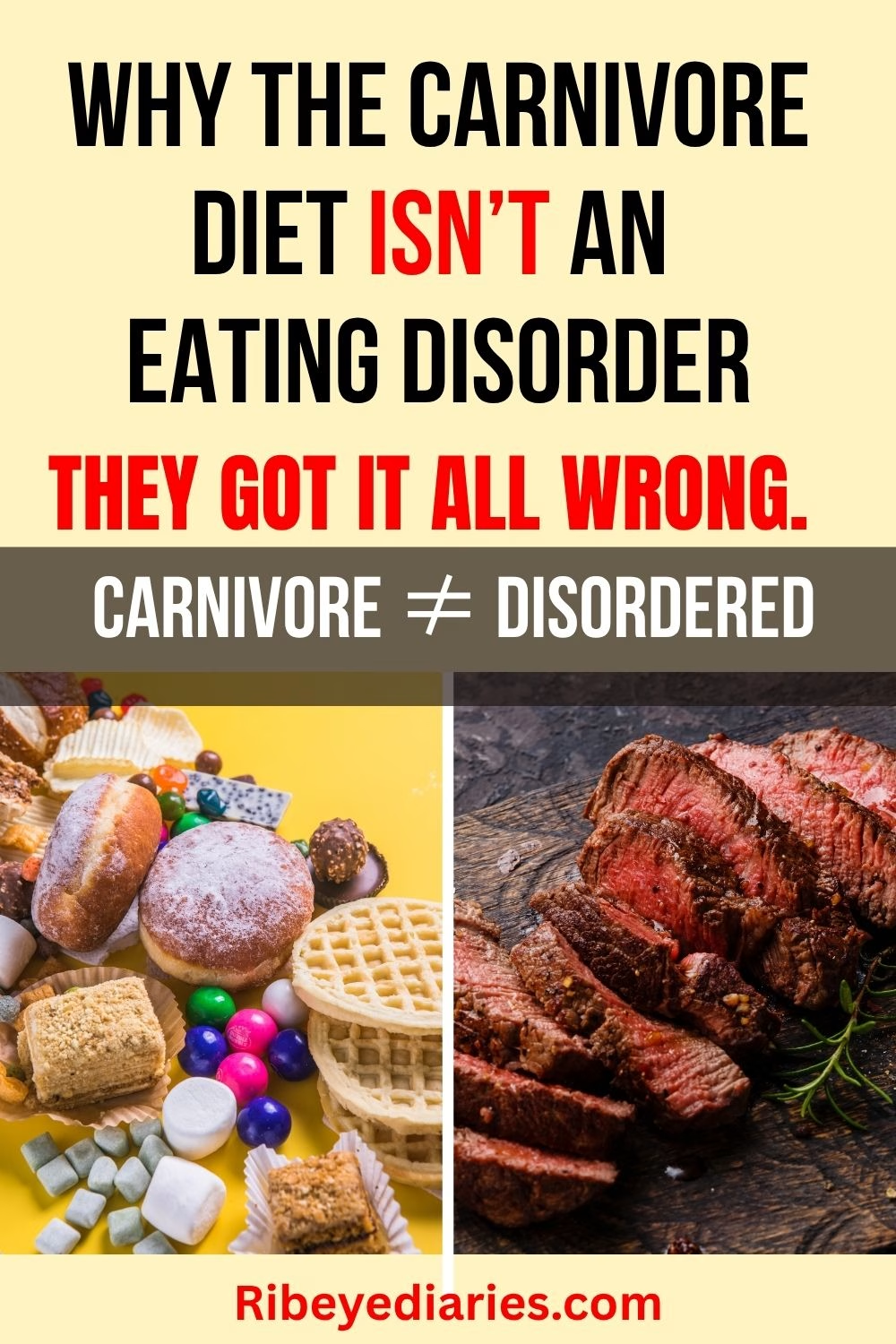
Say you’re on the carnivore diet and you’ll get all kinds of different reactions. Some people are curious, others are confused, some are concerned for your health. And occasionally, someone will throw out terms like “orthorexia” or “disordered eating.”
In this post, I’ll discuss what eating disorders actually are, why the carnivore diet doesn’t meet that definition, and how to spot the difference between a restrictive mindset and an intentional healing protocol. I’ll also talk about the rare cases where someone might use carnivore in a disordered way, and why that doesn’t define the diet as a whole.
If you’re choosing carnivore for your health, your healing, and/or your sanity, you deserve to stand firm in your decision without shame. I hope this post gives you the confidence (I wish I had when I first started) to trust your choices and respond with strength when someone accuses you of “disordered eating.”
Eating Disorders Explained
Before we start labeling people, we should probably understand exactly what an eating disorder is. According to the DSM-5, an eating disorder is a mental health condition characterized by:
- A disturbed relationship with food, body weight, or shape
- Extreme behaviors like restriction, binging, purging, or obsessive food control
- Distress, dysfunction, or harm to physical or mental health
You’re probably familiar with these common eating disorders:
- Anorexia Nervosa: extreme food restriction and an intense fear of weight gain
- Bulimia Nervosa: cycles of binging and purging
- Binge Eating Disorder: regular episodes of uncontrolled overeating
- Orthorexia (not yet officially in the DSM): an obsession with “eating clean” to the point of malnutrition or severe anxiety
So, the key question is:
Is the carnivore diet driven by fear, obsession, or harm?
For most people who eat this way, the answer is NO. And in fact, for many people, carnivore heals disordered eating patterns.
Why Carnivore Doesn’t Fit This Definition
Eating disorders are disorders. They involve intense distress, compulsive behavior, and usually physical or emotional damage.
Carnivore, on the other hand, is:
- Intentional – not compulsive
- Empowering – not fearful
- Restorative – not destructive
- Focused on nourishment – not deprivation
If you’re eating ribeyes and eggs to heal your hormones, regulate your blood sugar, and/or break free from food addiction, how could that be a disorder?
Think about someone with Celiac disease. If they consume gluten, it triggers an immune response that damages their intestine. They have to completely cut gluten out of their diets. We don’t tell them that they have “disordered eating” and they’re depriving themselves of bread. That would be crazy, right?
But for some reason, cutting out plant foods because it reverses your diabetes and insulin resistance, puts your PCOS into remission, heals your gut, calms autoimmune conditions, eliminates chronic pain, and stabilizes your mood is “disordered.”
Choosing carnivore is choosing to eat in a way that supports your mental and physical health, not cause harm. For most of us, it’s a diet that reduces or eliminates harm.
Can the Carnivore Diet Be an Eating Disorder?
I’ll play devil’s advocate here, just so we’re clear on every perspective. The carnivore diet itself is not an eating disorder, but it’s definitely possible that someone with an existing eating disorder could adopt this way of eating as part of their condition.
Here are a couple examples:
- Someone with ARFID (Avoidant/Restrictive Food Intake Disorder) could use carnivore as a way to excessively restrict and control food.
- People with orthorexia might fixate on a very limited set of foods (like meat only) as part of their condition.
In these cases, the diet could be used as a tool in their disordered eating patterns. However, this is rare and usually accompanied by:
- Distress, anxiety, or guilt around eating
- Obsessive thoughts about food rules
- Decline in physical and/or mental health
The vast majority of people who eat carnivore stick to this diet because it improves their relationship with food and reduces their anxiety.
Carnivore is a Healing, Nutrient-Dense Diet
There is a huge difference between starvation and restriction. Yes, the carnivore diet removes certain food groups completely. But it also includes the most nutrient-dense foods known to man (like steak, eggs, liver, butter, and bone broth).
Here are some of the many ways the carnivore diet heals and nourishes:
- Bioavailable: Animal foods are the most bioavailable source of nutrients a person can consume. Your body absorbs and uses the nutrients in meat and eggs far more efficiently than those found in plants.
- Anti-Inflammatory: Carnivore eliminates inflammatory foods such as seed oils and sugar, and anti-nutrients like oxalates and lectins.
- Nutrient-Dense: The carnivore diet provides large amounts of essential fats (saturated fat, cholesterol, omega 3s) and complete proteins that contain all 9 essential amino acids.
- Micronutrient-Rich: Liver and other organ meats provide bioavailable vitamins A, D, K2, B12, folate, copper, selenium, zinc, and iron. (And if you don’t eat organ meats like me, you can take freeze-dried liver supplements. Some carnivores don’t eat organs at all and have no deficiences after years on the diet.)
- Healing: Thousands of people report life-changing results on carnivore. Autoimmune remission, PCOS reversal, IBS/GI relief, mental health improvements, binge eating recovery, hormone balance, and weight loss have all been reported by long-term carnivores.
I tried carnivore as a last-ditch effort at controlling my PCOS and losing weight. I really didn’t have much faith it would help because I’d been trying to find a solution for decades before. But once I stuck to it for a few weeks, and then a few months, the weight came off and my symptoms completely reversed.
This diet feels like a miracle to so many of us who were suffering needlessly due to a lifetime of eating the Standard American Diet (SAD).
Freedom from Obsession
You know what’s disordered? Spending your whole life counting calories, feeling guilty every time you eat, binging, restricting, yo-yoing, and thinking about food every hour of the day.
The carnivore diet helps many people finally break free from that cycle.
Personally, eating this way has stopped all the food noise. I used to think about food constantly, literally from the time I woke up until I fell asleep at night. As soon as I finished one meal, I’d start thinking about what I’d eat next. It was an exhausting and unhealthy way to live. All that is gone when I stick to carnivore.
Carnivore gave me food peace – not a disorder. It actually destroyed any semblance of an eating disorder that I had before.
Not Everyone Will Understand
Carnivore is vastly different from what most people were taught about nutrition. It contradicts the food pyramid that was hammered into our heads as kids and decades of marketing that convinced us to fear fat, eat our vegetables, and don’t forget the whole grains!
We were raised on sugar, seed oils, low-fat dogma, and the idea that red meat would kill us. So when someone starts eating only meat, eggs, and butter, it can seem extreme.
However, I believe the status quo is wrong.
I believe the rise in obesity, cancer, heart disease, autoimmune conditions, diabetes, infertility, and mental illness isn’t despite the modern diet, but because of it.
Carnivore challenges the standard narrative. It questions the idea that fiber is essential, that plants are harmless, or that sugar is fine “in moderation.” Most people are stuck in their ways, and this challenge makes them uncomfortable.
But different doesn’t mean disordered. Just because it goes against the norm doesn’t mean it’s dangerous. For many of us, it’s actually the path back to good health. And if this works for you like it has for me, it really doesn’t matter what anyone else believes.
Let’s Stop Pathologizing Personal Choice
There is a big difference between disordered eating and intentional eating.
The carnivore diet is not about avoiding food out of fear, and it’s not a compulsion. It’s also not about control or punishment.
It is about removing the foods that are harming your body and choosing the foods that make you feel best.
Most of us got to this point after trying everything else – calorie counting, Weight Watchers, intuitive eating, keto, paleo, vegan, etc. You name it and many of us have tried it. (Not to mention the endless yo-yo dieting and binge/purge cycles.)
But when nothing else worked, carnivore did.
So let’s stop pathologizing personal dietary choices. Just because someone doesn’t eat the way you do doesn’t mean they’re sick or disordered.
Sometimes the only way to heal is to take our health into our own hands. When the modern diet and healthcare industry has failed us, maybe it’s time to do something totally opposite of what we’ve been told.
Good luck out there!
PS. If you enjoyed this post, check out my YouTube video, where I cover this topic in more detail: